/
·


Content Strategist & Chartered Accountant (CA)
✅ Sparkonomy built this guide from hands-on research into how Indian Creators invoice brands, agencies, and barter deals. Our team studied real Creator workflows, WhatsApp-led negotiations, GST/TDS requirements, PO-number delays, proof-of-work gaps, and payment follow-up patterns to explain why invoicing is no longer a design task. It is a payment operation Creators must run clearly and confidently.
Sara is a beauty Creator from Indore. She sends her invoice after finishing a brand campaign.
The Reel is live.
The screenshots are shared.
The brand team has approved the work. But 30 days later, the payment is still stuck.
This is the quiet problem inside India’s booming creator economy. Indian creators already influence over $350 billion in annual consumer spending, yet only 8–10% monetize their content effectively. For many, the bigger daily struggle is still basic: delayed payments, unclear invoices, and constant follow-ups.
In fact, freelancer invoicing research suggests that around 40% of self-employed workers have at least one overdue invoice at any time.
The issue is not always that brands refuse to pay. Often, the invoice itself is incomplete. Missing PO numbers, unclear tax lines, no proof of work, or weak payment terms give finance teams one more reason to push it down the queue.
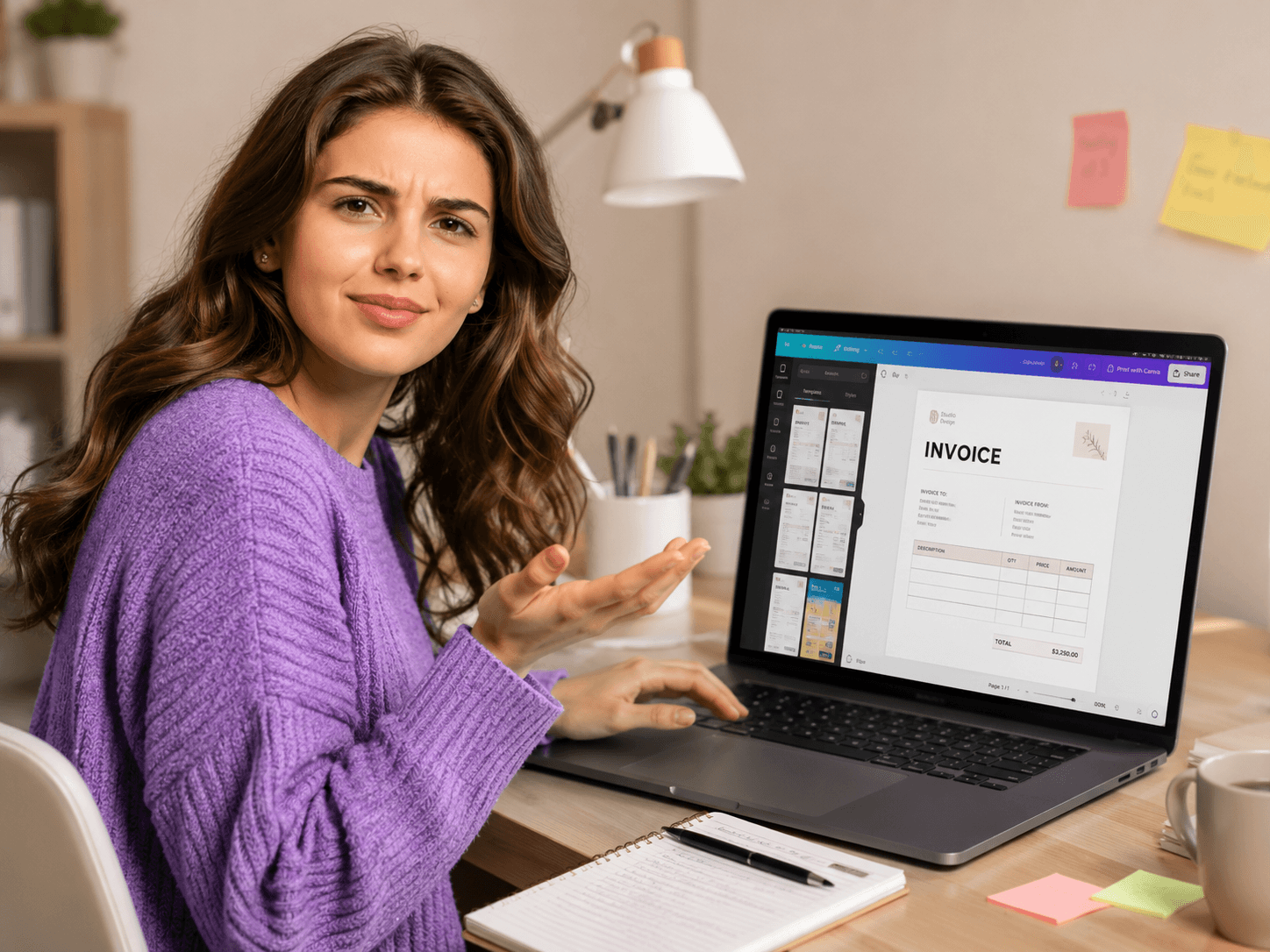
A static Canva template ends the moment you hit “download PDF.” It does not calculate your GST or TDS. It does not remember the brand’s PO number.
It does not send a follow-up when Day 30 passes without payment. Every invoice you rebuild from scratch costs unbillable time, and every untracked overdue deal chips away at your cash flow.
Understanding the full Creator invoicing lifecycle starts with one truth: billing and getting paid are not the same thing.
An AI invoice generator does not start with a blank template. It starts where most Creator deals actually happen: inside WhatsApp chats, voice notes, emails, screenshots, and half-confirmed brand messages.
Instead of asking you to design an invoice first, it reads the deal details, pulls out the key information, applies the right tax fields, and turns the whole thing into a payment-ready workflow.
Here’s what that looks like in real life.
A mid-tier lifestyle Creator in Pune described her invoicing week to us. Eight active brand deals. All at once. Three through agencies. Five direct. Every single negotiation on WhatsApp.
By the time she opens her laptop to invoice? She’s rebuilding agreed terms from a 40-message thread.
Manually calculating 18% GST on a barter-plus-cash deal. Guessing whether the agency or the brand withholds TDS. She told us she spent eleven hours across four days last March doing nothing but invoicing.
Eleven hours. Just paperwork.
With an AI invoice generator, that workflow changes at the point of agreement. She forwards her WhatsApp screenshot, or records a 30-second voice note, and the tool parses the deal terms: three Reels, two Stories, ₹80,000 fee, 18% GST, 10% TDS under Section 194J, Net 15 payment.
The invoice builds itself. GST and TDS calculate automatically. The invoice goes to the brand via WhatsApp or email directly from the platform. A reminder fires on Day 15 if payment hasn’t cleared.
Her proof-of-work analytics screenshot attaches as a second page. Every invoice logs to a dashboard she can hand to her CA in April without touching a spreadsheet.
This is the real difference. Canva is perfect when a Creator needs an invoice that looks good. An AI invoice generator is built for when a creator needs an invoice that works.
One that understands Reels, Stories, usage rights, GST, TDS, proof links, payment terms, and follow-ups. And it keeps working until the creator gets paid.
From what we’ve seen talking to Creators: the biggest misconception about AI invoicing is that it replaces the design step. It doesn’t. It replaces the eleven steps that happen after design. Tax math, delivery, tracking, reminders, dispute logging, and tax-season reporting.
For a Creator sending two or more invoices per month, this adds up to several hours of admin work each week. Based on the time Creators tell us they spend on manual invoicing, switching to an automated tool can recover an estimated 3 to 4 hours per week.
Sparkonomy Team
A compliant Creator invoice is not just a good-looking PDF. It is the document a brand’s finance team uses to approve your payment.

Every field has a job: PAN confirms who is billing, GSTIN supports tax filing, PO number links the invoice to internal approvals, and deliverables prove what work was done.
That is why a payment-ready invoice looks very different from a pretty template.
Example 1: The Agency Deal Creator
A Delhi-based tech reviewer earning ₹60,000 to ₹1,20,000 per brand deal (all through agencies) shared that his invoices were rejected twice in one quarter. Once for a missing PO number.
Once for not showing TDS as a separate line item. His agency withholds 10% TDS plus takes a 15% commission. That means two deductions need to appear clearly on one document.
The math on a single invoice:
Worked Example: ₹1,00,000 Agency Deal
Gross Fee: ₹1,00,000
Agency Commission (15%): −₹15,000
Subtotal: ₹85,000
TDS at 10% under Section 194J: −₹10,000
Net Payable to Creator: ₹75,000
Using the tool, all five lines show up automatically on one clean document. The brand’s procurement team approves it in one pass. He received payment within 18 days instead of his previous 60-day average.
Two separate deductions on one professional document eliminate the back-and-forth that delays payments for agency-routed Creators.
Example 2: The Micro-Creator Hitting the Template Wall
A Bengaluru food-and-travel Creator with 28,000 followers described saving invoices as “Invoice Final,” “Invoice Final 2,” and “Invoice ACTUAL Final.”
She’d grown from two brand deals per month to nine in under a year. She told us she spent all of March trying to figure out which brands had paid.
After switching to Sparkonomy on her phone, she builds each invoice in under two minutes from a saved client profile. Auto-reminders send on Day 7 and Day 21.
Her dashboard shows three invoices paid, two pending, and one overdue, at a glance, without a spreadsheet. At tax time, she exports a complete income summary sorted by brand, month, and payment status.
Bottom line: Scalability exhaustion hits solo Creators earlier than anyone expects. A mobile-first AI tool removes the wall before it costs you clients.
Pro tip: Creators who attach proof-of-work analytics screenshots inside their invoice (rather than sending them separately) report far fewer “we need your performance report before releasing payment” delays from brand finance teams. Sparkonomy lets you attach these as a standard second page.
Most Creators do not invoice badly because they are careless. They invoice badly because nobody teaches them what brands actually check before releasing payment.
So they focus on design, while finance teams look for tax fields, proof, payment terms, and clean records.
Myth: A visually polished, on-brand invoice design signals credibility to brands.
Reality: Brand finance and procurement teams evaluate invoices for legal and tax compliance, not design. A Canva template that omits PAN, GSTIN, TDS line, and PO number will be rejected no matter how well it matches your Instagram palette. According to the Central Goods and Services Tax Act, 2017, GST-registered suppliers must display GSTIN, HSN/SAC codes, and a tax computation breakdown on every invoice. These fields matter to brand finance teams. Color palettes don’t.
Why it matters: Submitting a beautiful but non-compliant invoice delays payment by weeks. It also signals that you’re not familiar with formal business processes. The opposite of the professionalism you intended.
Free? Run the numbers.
Miss one follow-up on a ₹50,000 invoice and you are behind your payments for another 30 to 45 days. That’s expensive.
That Canva template isn’t free. It’s the most expensive tool in your stack. You just can’t see the price tag.
Why it matters: Free templates generate hidden costs at exactly the scale (5 to 10 deals per month) where Creators most need their time back.
Myth: Any reference number works. The date, a random code, or “Invoice 1.”
Reality: Making up random invoice numbers creates friction during tax filing, brand audits, and payment disputes. It also signals to brand finance teams that you operate informally, which drops your payment priority relative to registered vendors. A consistent format like INV-2025-BRANDNAME-001 takes thirty seconds to set up once.
Why it matters: That thirty-second setup protects you during every GST filing, TDS reconciliation, and dispute resolution for years.
Something we keep hearing from Creators but rarely see discussed publicly: most payment delays aren’t caused by brands refusing to pay. They’re caused by procurement workflows that treat a ₹80,000 Creator invoice with the same approval chain as an ₹80 lakh vendor contract. Same three-signatory process.
Same 45-day cycle.

An AI invoice generator doesn’t change that system. But it removes every delay that’s on your side of the table, so when the brand is ready to pay, nothing on your end holds it up.
With that context: if you’re managing one or two brand deals a month, a well-structured Canva template with the right fields (PAN, GSTIN if applicable, TDS line, usage rights clause) will serve you fine.
In fact, we have created a free Canva invoice template for you. Go ahead and use it if you only send one or two invoices a month.
But the moment your deal count crosses two per month, or you start working with mid-size and large corporate brands, you’re no longer running an invoicing task.
You’re running a payment operation. And a static PDF is not an operation. It’s a one-time output with no memory, no follow-through, and no audit trail.
Once your deal count crosses two per month, five things change:
Disclaimer: This article is a starting point only. It is designed to help Creators understand AI invoice generators and invoicing compliance using plain language. It does not replace professional financial, tax, or legal advice. For any Creator-specific questions on GST, TDS, invoicing structure, contracts, or business compliance, please consult a qualified finance professional or Chartered Accountant.
Now that you understand the difference, Sparkonomy’s AI invoice generator helps you build GST and TDS-compliant Creator invoices from a WhatsApp screenshot or voice note. No template. No spreadsheet. No manual follow-up. Ever again. Join Indian Creators using Sparkonomy to get paid faster.
Sparkonomy’s free Creator Invoice Compliance Checklist breaks down every field Indian brand procurement teams check before releasing payment. GST, TDS, PO number, usage rights, and proof of work, all in a one-page format you can spark into action on your next invoice. Free, and used by thousands of Creators.
Get the Free Compliance Checklist→
I help Creators turn their hobby into a real business. I am a Chartered Accountant (CA) with 12 years of experience, and at Sparkonomy I write simple guides on money, systems, and how AI can complement your work by taking care of boring admin, so you can create more while building a career that lasts.
Trusted by teams at: